





Lemongrass Capsules vs Lemongrass Essential Oil is a safety-literacy topic because both products may come from the same aromatic plant family, but they are not used the same way. A capsule may contain dried lemongrass powder or extract inside a supplement shell. An essential oil is a highly concentrated aromatic product. Treating one like the other can create unsafe expectations.
The confusion usually starts with a simple thought: “If both say lemongrass, they must be close enough.” That is not how botanical products work. Product format, concentration, route of use, plant part, extraction method, label category, and warnings all matter. Secrets Of The Tribe treats this as label-reading discipline: the plant name is only the starting point, not the full safety decision.
This article does not provide medical advice. Lemongrass capsules, lemongrass essential oil, teas, tinctures, powders, dried herbs, extracts, and supplements are not intended for medical diagnosis, medical care, symptom management, skin care decisions, infection concerns, digestive concerns, respiratory concerns, or replacement of professional guidance. If you are pregnant or breastfeeding, under 18, taking medication, preparing for surgery, using several supplements, managing a health condition, or unsure whether a lemongrass product is appropriate for you, ask a qualified healthcare professional before use.
Are Lemongrass Capsules and Lemongrass Essential Oil the Same?
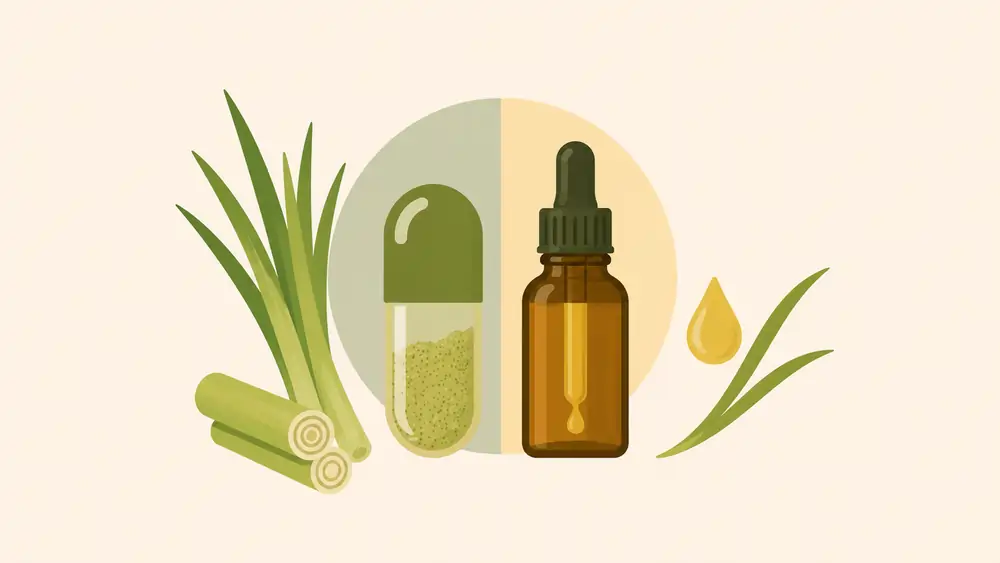

No. Lemongrass capsules and lemongrass essential oil are different product categories.
Lemongrass capsules are usually dietary supplement products meant to be used according to a Supplement Facts panel. Lemongrass essential oil is a concentrated aromatic oil used in fragrance, diffusion, topical-product, or aromatherapy-style contexts depending on the label.
Same plant name does not mean same route, same strength, or same safety rules.
Quick Comparison: Capsules vs Essential Oil
| Feature | Lemongrass Capsules | Lemongrass Essential Oil |
|---|---|---|
| Main product category | Dietary supplement | Concentrated aromatic product |
| Typical form | Powder or extract inside capsule shell | Volatile oil in a small bottle |
| Label panel | Supplement Facts | Use directions and safety warnings |
| Common route | Swallowed as directed on label | Often aromatic or topical context, based on label |
| Main buyer mistake | Thinking capsules equal oil | Thinking oil can replace capsules or tea |
Why Concentration Changes the Rules
Essential oil is concentrated. That is the key difference.
Lemongrass essential oil contains volatile aromatic compounds separated from plant material. It can smell much stronger than dried herb, tea, or capsules because a small amount carries a sharp aromatic profile.
Concentration changes how a product should be handled, labeled, stored, and used.
Why Route of Use Matters
Route of use means how a product enters or contacts the body.
A swallowed capsule, a brewed tea, a skin product, a diffuser oil, and a room fragrance are different routes. Each route has different safety questions. A product made for one route should not be moved to another route based on plant name alone.
Do not treat lemongrass essential oil like a capsule, tea, or dried herb.
Why Essential Oil Is Not a Capsule Substitute
Lemongrass essential oil should not be used as a substitute for lemongrass capsules.
A capsule serving is defined by its Supplement Facts panel. An essential oil bottle does not become a supplement serving just because it comes from lemongrass. The oil is concentrated and may not be labeled for internal use.
If the label does not clearly support a route of use, do not invent one.
Why Capsules Are Not Essential Oil in a Shell
Lemongrass capsules are not automatically essential oil placed inside a capsule shell.
Many capsules contain dried plant powder, aerial parts, leaf powder, stem material, extract, or a blend. They may include capsule material and other ingredients. The formula should be shown on the label.
Assuming every capsule contains essential oil is a label-reading mistake.
Why “Same Plant” Is Not Enough
A plant can become many different products.
Fresh lemongrass stalks, dried lemongrass tea, lemongrass capsules, lemongrass tincture, lemongrass extract, and lemongrass essential oil can all begin with a similar plant identity. They do not become the same product.
Processing changes concentration, texture, aroma, route, and label requirements.
Product Format Changes the Safety Question
| Product Format | Main Question to Ask | Common Mistake |
|---|---|---|
| Fresh lemongrass stalks | Is it clean, fresh, and used as food? | Assuming cooking amount equals supplement serving |
| Lemongrass tea | Is it a tea-grade herb and brewed as directed? | Assuming tea aroma predicts capsule smell |
| Lemongrass capsules | What does the Supplement Facts panel say? | Ignoring serving size and warnings |
| Lemongrass essential oil | What route of use does the label allow? | Treating oil like food, tea, or capsules |
| Lemongrass topical product | Is it formulated for skin contact? | Using undiluted oil or wrong product type |
Why Lemongrass Essential Oil Can Irritate
Lemongrass essential oil can be irritating when misused because it is concentrated and aromatic.
Skin, eyes, lips, nose, mouth, and mucous membranes can be sensitive to concentrated oils. Some people may react more strongly than others. Essential oils can also cause problems when used in the wrong amount, wrong route, or wrong product context.
A pleasant smell does not make an essential oil casual or risk-free.
Why Mucous Membranes Need Extra Caution
Mucous membranes include areas such as the mouth, nose, lips, and eyes. These areas can react more strongly than ordinary skin.
Concentrated aromatic oils should not be placed on sensitive areas unless a properly labeled product and qualified guidance support that use.
Do not use lemongrass essential oil as a mouth product, capsule, tea ingredient, or direct skin shortcut.
Why “Natural” Does Not Mean Gentle
Natural products can still be strong, irritating, unsuitable, or incorrectly used.
Lemongrass essential oil is natural in origin, but it is also concentrated. Capsules are natural in concept too, but they still need label review. Natural origin does not replace instructions, warnings, or personal safety context.
Respect the format, not just the plant source.
Why Essential Oil Labels Need Careful Reading
An essential oil label should be read for botanical name, use directions, dilution guidance if applicable, warnings, storage instructions, expiration or best-by information, batch code, and product category.
Some essential oil products are intended for aroma use only. Some are part of formulated topical products. Some are not suitable for internal use. The label should decide the use context, not the buyer’s assumption.
Never use oil in a way the label does not support.
Why Capsule Labels Need Different Reading
A capsule label should be read for Supplement Facts, serving size, botanical name, plant part, powder or extract type, other ingredients, capsule material, suggested use, warnings, storage instructions, expiration date, and lot number.
This is different from reading an essential oil bottle. The serving logic and safety questions are not the same.
A capsule is a supplement product, not an aroma bottle.
Why Botanical Name Still Matters
The botanical name helps confirm plant identity.
Lemongrass commonly appears as Cymbopogon citratus, though related Cymbopogon species may appear in some contexts. Citronella grasses are also Cymbopogon plants, which can confuse buyers.
A label that says only “lemongrass” is less clear than one that lists the botanical name.
Why Plant Part and Extraction Method Matter
Plant part and extraction method shape the product.
Capsules may contain leaf, aerial parts, stem, dried herb powder, or extract. Essential oil is produced by separating volatile aromatic oil from plant material. The result is not the same as powdered herb.
Plant identity matters, but processing determines the product category.
Why Smell Can Mislead Buyers
Lemongrass essential oil often smells much stronger than capsules. That strong aroma can make the oil feel more “real” to a buyer.
Strong smell does not mean better for every purpose. It means the aromatic compounds are concentrated and easy to detect.
Capsules can smell mild because the plant material is dry, enclosed, or less volatile in that format.
Why Essential Oil Should Not Be Added to Capsules or Tea
Do not add lemongrass essential oil to capsules, tea, water, food, or homemade supplement routines unless a qualified professional and a product label specifically support that use.
Essential oils are concentrated and can irritate sensitive tissue. Home mixing can also create uneven exposure and unclear amounts.
Use products only as labeled.
Why Essential Oil Should Not Be Used as a Shortcut
Essential oil may look efficient because one small bottle smells powerful.
That power is exactly why it needs caution. A stronger smell does not make it a shortcut for capsules, teas, tinctures, or fresh lemongrass. It simply means the format is different and more concentrated.
Shortcut thinking is risky with essential oils.
Why Diffusion Is Not the Same as Supplement Use
Diffusion is an aroma route. Supplement capsules are an oral product route.
Diffusing an oil, when the product is labeled for that use, does not make the oil a supplement. Swallowing capsules does not make them an aromatherapy product. Each route has its own safety questions.
Keep product routes separate.
Why Topical Products Are a Separate Category
A formulated topical product is not the same as a bottle of essential oil.
Topical products may include carrier oils, creams, lotions, dilution, preservatives, or other ingredients. Undiluted essential oil can be too strong for some skin contact. Capsule powder is also not a topical product.
Do not move products between categories without label support.
When Lemongrass Capsules Should Not Be Used
Do not use lemongrass capsules if the seal is broken, capsules are wet, sticky, swollen, leaking, clumped, moldy, damaged, or expired.
Also avoid products with rancid, damp, chemical, rotten, or unusually sour odor. Do not taste-test suspicious capsules.
Contact the brand with the lot number and expiration date if a quality issue appears.
When Lemongrass Essential Oil Should Not Be Used
Do not use lemongrass essential oil if the bottle is leaking, unlabeled, contaminated, past its usable date, or missing clear directions.
Do not use it on eyes, lips, mouth, broken skin, or sensitive areas. Do not swallow it unless the product is explicitly labeled for that route and a qualified professional has confirmed it is appropriate for your situation.
If irritation appears, stop use and seek appropriate guidance.
Who Should Be Extra Careful?
Extra caution matters for children and teens, pregnant or breastfeeding people, medication users, people with asthma or respiratory sensitivity, people with skin sensitivity, people with allergies, surgery patients, and people with health conditions.
Pets can also be sensitive to essential oils. Keep aromatic oils away from children and animals unless a qualified professional gives appropriate product-specific guidance.
Personal context matters more than plant familiarity.
Why Brand and Product Support Matter
A clear company should explain product category, ingredient identity, plant part, directions, warnings, batch details, and storage.
For supplements, ask about botanical name, plant part, powder or extract type, serving size, and quality questions. For essential oils, ask about botanical name, intended route, concentration, testing, storage, and safety directions. Secrets Of The Tribe takes a cautious editorial stance here: buyer confidence should come from label clarity, not from assuming all lemongrass products follow the same rules.
Lemongrass Capsules vs Lemongrass Essential Oil Checklist
Use this checklist before comparing lemongrass capsules with lemongrass essential oil. The goal is to keep product category, route of use, and concentration separate.
Identify the Product Category
Decide whether the product is a dietary supplement, essential oil, tea, topical product, or food ingredient.
Check the Botanical Name
Look for Cymbopogon citratus or another clearly named Cymbopogon species.
Check the Route of Use
Use the product only in the way the label supports. Do not move it to another route based on plant name.
Respect Concentration
Essential oil is highly concentrated compared with dried herb, tea, or capsules.
Read the Correct Label Panel
Use Supplement Facts for capsules and product-specific directions for essential oils.
Do Not Add Oil to Capsules or Tea
Do not turn essential oil into a homemade supplement or drink ingredient.
Protect Sensitive Areas
Keep essential oils away from eyes, mouth, lips, broken skin, and other sensitive tissue unless a properly labeled product supports use.
Check Product Integrity
Avoid broken seals, leaks, moisture damage, contamination, bad odor, damaged capsules, or expired products.
Ask When Health Context Matters
If you take medication or have a health condition, ask a qualified professional before use.
Common Mistakes to Avoid
Thinking Essential Oil Replaces Capsules
Lemongrass essential oil is not a substitute for lemongrass capsules.
Thinking Capsules Are Essential Oil
Capsules may contain dried herb powder, extract, or blends, not essential oil.
Ignoring Route of Use
Swallowed products, topical products, and aromatic products follow different safety rules.
Trusting Strong Smell Too Much
Strong aroma does not prove a product is more appropriate for your purpose.
Using Essential Oil Internally Without Label Support
Do not swallow essential oils unless the product label and qualified guidance clearly support that use.
FAQ
Are lemongrass capsules the same as lemongrass essential oil?
No. Capsules are dietary supplement products, while essential oil is a concentrated aromatic product.
Can lemongrass essential oil replace lemongrass capsules?
No. Essential oil should not be used as a substitute for capsules.
Can I swallow lemongrass essential oil?
Do not swallow lemongrass essential oil unless the product is explicitly labeled for that route and a qualified professional confirms it is appropriate.
Why does lemongrass essential oil smell stronger than capsules?
Essential oil is concentrated and contains volatile aromatic compounds that are easy to smell.
Do lemongrass capsules contain essential oil?
Not necessarily. They may contain dried herb powder, extract, or a blend. Read the label.
Can lemongrass essential oil irritate skin?
Yes, it can irritate skin or sensitive tissue when misused, especially because it is concentrated.
What should I check on a lemongrass capsule label?
Check Supplement Facts, botanical name, plant part, serving size, other ingredients, warnings, storage, expiration date, and lot number.
What should I check on an essential oil label?
Check botanical name, intended use, safety warnings, storage, batch code, expiration or best-by information, and route directions.
Is lemongrass tea the same as essential oil?
No. Tea is an infusion of plant material in water, while essential oil is a concentrated aromatic product.
Glossary
Lemongrass Capsules
A supplement format that contains lemongrass powder, extract, or formula material inside capsule shells.
Lemongrass Essential Oil
A concentrated aromatic oil produced from lemongrass plant material.
Cymbopogon citratus
A botanical name commonly associated with lemongrass used in food and herbal product contexts.
Essential Oil
A concentrated volatile aromatic product from plant material.
Route of Use
The way a product is used or contacts the body, such as oral, topical, or aromatic use.
Concentration
The strength or density of active aromatic material in a product format.
Supplement Facts
The label panel that lists serving size and dietary ingredients in a supplement product.
Plant Part
The part of a plant used in a product, such as leaf, stem, aerial parts, powder, extract, or oil.
Mucous Membranes
Sensitive tissues such as the mouth, nose, lips, and eyes.
Volatile Compounds
Aromatic compounds that evaporate easily and contribute to smell.
Conclusion
Lemongrass Capsules vs Lemongrass Essential Oil is a product-category and concentration issue. Same plant name does not make capsules, tea, topical products, and essential oils interchangeable, so always follow label directions, route of use, and safety warnings.
Sources
Lemongrass botanical profile and Cymbopogon citratus accepted species information, Plants of the World Online / Royal Botanic Gardens, Kew – powo.science.kew.org/taxon/urn:lsid:ipni.org:names:396713-1
Lemongrass culinary and botanical overview, Encyclopaedia Britannica – britannica.com/plant/lemongrass
Essential oil safety overview and general consumer cautions, National Association for Holistic Aromatherapy – naha.org/explore-aromatherapy/safety
Dietary supplement labeling guidance, Dietary Supplement Labeling Guide – fda.gov/food/dietary-supplements-guidance-documents-regulatory-information/dietary-supplement-labeling-guide
Essential oil safety and poison exposure information, National Capital Poison Center – poison.org/articles/essential-oils
Dietary and herbal supplement safety overview, Dietary and Herbal Supplements – nccih.nih.gov/health/dietary-and-herbal-supplements
Structure/function claim guidance for dietary supplements, Structure/Function Claims – fda.gov/food/nutrition-food-labeling-and-critical-foods/structurefunction-claims