






Credit:
NIST
On March 23, 1916, officials and citizens gathered in Washington, D.C., to celebrate a new era in the nation’s ability to measure.
Secretary of Commerce William C. Redfield took his place at the podium to celebrate the beginning of construction of NIST’s (then known as the National Bureau of Standards) Chemical Laboratory, saying the expansion would add to a vital service that “pushes back more and more each day the shades of darkness that limit our present knowledge.”
Redfield then helped set a massive one-ton cornerstone into place, signifying the federal government’s commitment to supporting American innovation.
Following the secretary, Director Samuel W. Stratton traced the institution’s lineage from its 1901 formation from the Office of Weights and Measures to its becoming a pillar of the Department of Commerce 15 years later.
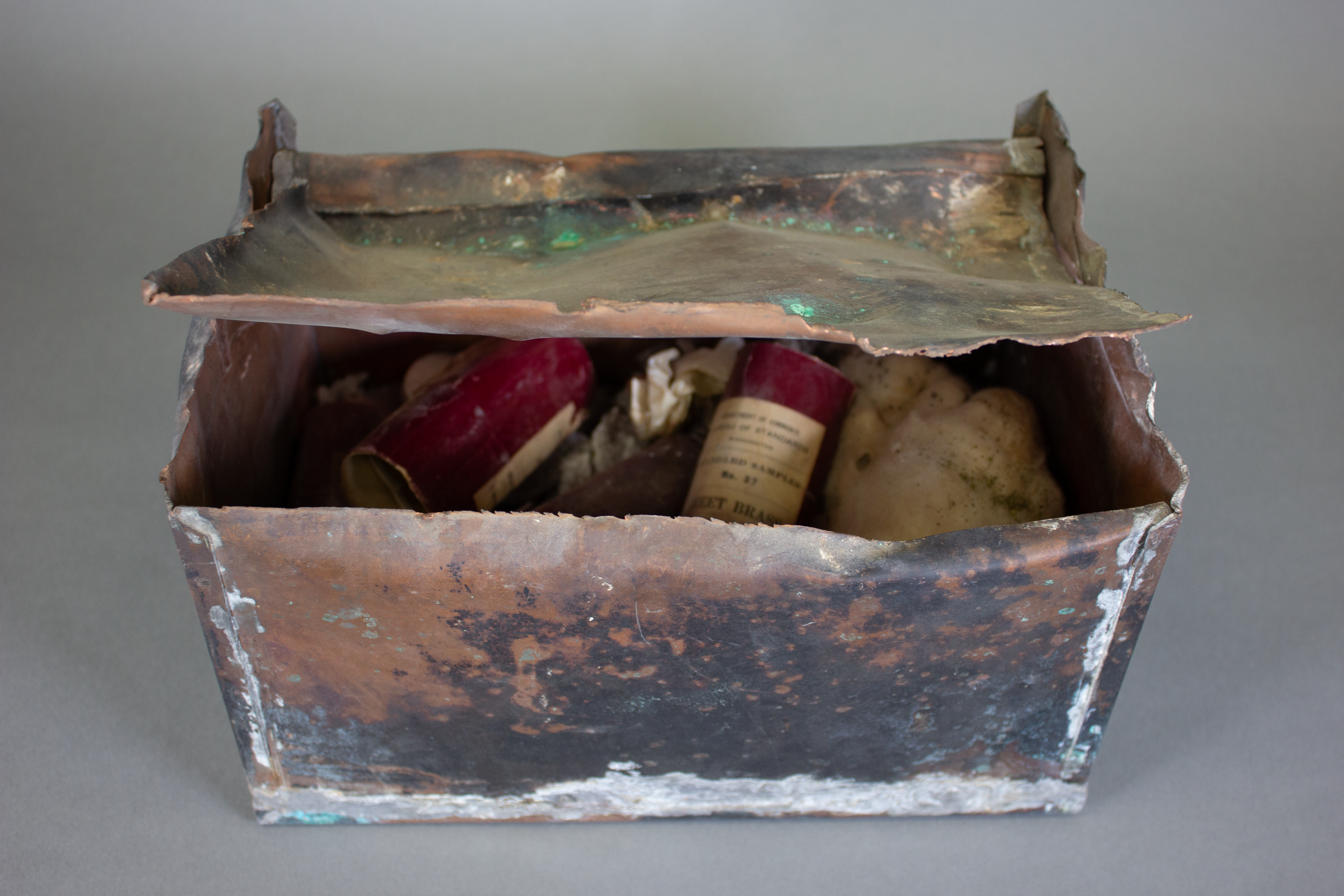
To bridge the gap between their present and their successors’ future, Chief Chemist William F. Hillebrand and his company of chemists deposited a hermetically sealed copper box inside the stone.
Credit:
NIST Digital Archives (NDA)
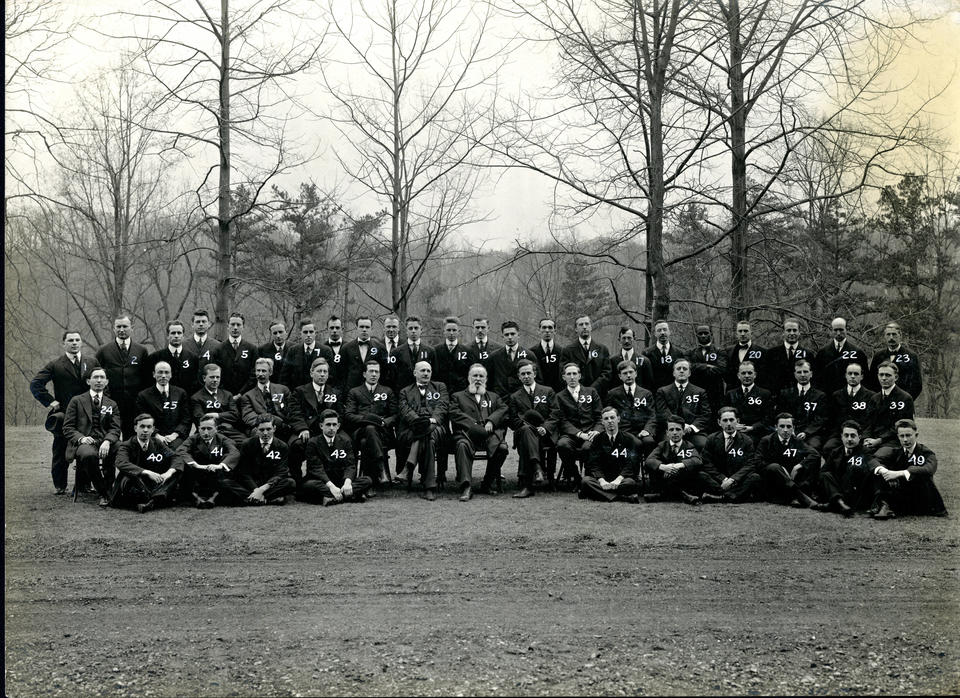
Within the time capsule was no mere collection of memorabilia but a carefully calibrated archive of the agency’s chemical capabilities, including a roster of the staff, blueprints of the structure and a reel of moving picture film of the 1915 groundbreaking ceremony. Most importantly, the box contained six early standard reference materials (SRMs) — including Bessemer steel, sheet brass and sodium oxalate — to testify to the quality of the chemists’ work. Ever meticulous, they even added bottles of quicklime to maintain a dry environment so moisture would not destroy their message to the future.
Unearthed and Nearly Lost
Despite their precautions, the message came precariously close to being lost when the original campus was demolished in the 1980s, years after NIST’s headquarters had been relocated to Gaithersburg, Maryland. During the razing, a bulldozer driver unearthed the copper canister from the rubble. With no one around to claim it, he took it home, stashed it in his basement and promptly forgot about it.
Coming upon it a few years later, the bulldozer driver’s curiosity was reawakened, and he cut the box open with a torch. He found what appeared to be uninteresting bottles and documents. Although there was nothing of value to him in it, the man returned the box to its place in his cellar, where it sat waiting.
Credit:
NIST Museum/Sarah Reeves
Eventually, providence would intervene. The existence of the box was revealed through a chance conversation that Don Johnson, then director of Technology Services at NIST, had with a fellow parishioner at his church in 1992. Though Johnson left NIST before he could investigate, he handed the lead to Barry I. Diamondstone, deputy director of the Chemical Sciences and Technology Laboratory.
Diamondstone embarked on an exhaustive search, navigating a long trail of contacts until he finally located the bulldozer driver in early 1994. Upon learning that NIST was interested only in the box’s historical significance, not the circumstances of its disappearance, the man invited Diamondstone to his home to retrieve the long-lost chest of treasures.
What Remains
While the recovery was cause for celebration, it was tinged with loss. The heat of the torch used to open the capsule had scorched several items. Several of the SRM containers were broken and their contents scattered. Sadly, the reel of film had vanished after the worker who found it gave it to a friend to be transferred to videotape.
Yet, the core of the missive survived. Today, the recovered rosters, the photographs and the remaining Bessemer steel and brass samples are housed in the NIST Research Library and Museum. There, they stand as a testament to the work NIST has done during the past 125 years to push back the darkness that limits our knowledge.