





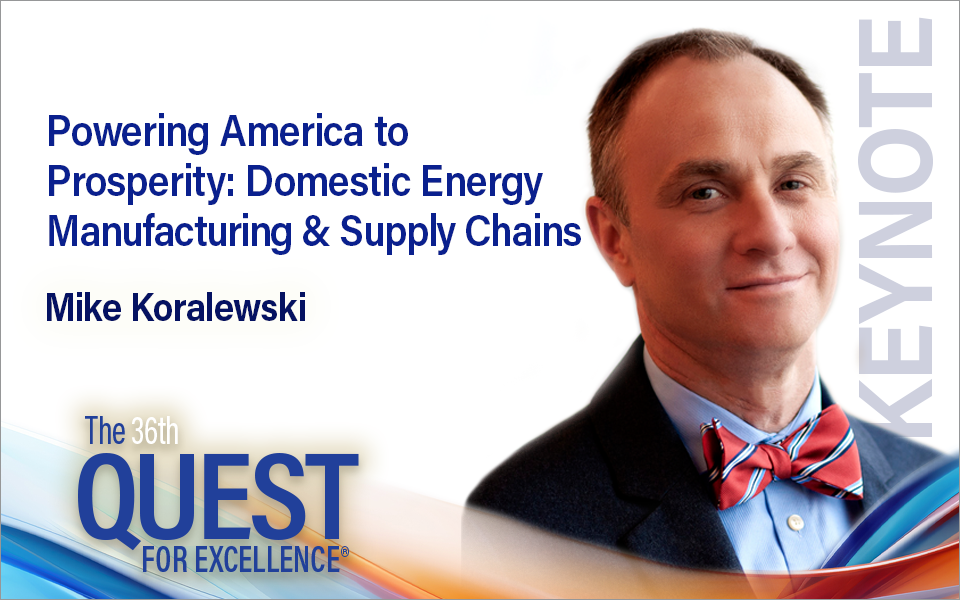
During the Quest for Excellence® Conference earlier this month, Michael (“Mike”) Koralewski, chief supply chain officer of First Solar, delivered a keynote presentation based on his work in the field of electric energy. Following is an exchange I had with him recently in which he recaps key points and shares related thoughts.
Please briefly describe your presentation, “Powering America to Prosperity: Domestic Energy Manufacturing & Supply Chains.”
We believe that restoring America to greatness will drive economic growth and energy independence, while securing our nation. The next four years also present the opportunity to unlock America’s potential to become the world’s foremost electric economy—an economy efficiently, reliably, and affordably powered by abundantly available domestic energy, generated by American-made technology, made by American workers, and with an American supply chain.
What are the key points you’d like people to take away from your presentation?
- First Solar, which has invested over $4.5 billion in U.S. manufacturing and research and development (R&D) infrastructure, is an example of how American companies can manufacture uniquely American products in the United States with American supply chains.
- The United States is on the cusp of the first meaningful growth in electricity demand this century, and this requires a commonsense, all-of-the-above energy generation strategy that relies on American-made power generation technologies.
- First Solar’s American supply chain spans the nation, sourcing materials and supporting the employment of thousands of hardworking people across the country: soda ash miners in Wyoming; silica miners in Michigan; copper miners in Utah; steelworkers in Alabama, Louisiana, and Ohio; glass workers in Illinois, Ohio, and Pennsylvania; woodworkers in Indiana; and a nationwide network of truckers, railroad workers, and many more.
What inspired you to become a leader in the solar energy industry?
My journey with First Solar began almost two decades ago, and throughout this time, we’ve adapted to address emerging opportunities in the power generation space. Solar technology has come a long way in the past 20 years: solar has gone from needing subsidies to being competitive on a standalone basis; and it has gone from being a niche technology to an enabler of grid stability and provider of peak and baseload energy.
I’m proud not just to have had a ringside view, but also to have played a role in the evolution of solar as a technology that can—and does—stand shoulder-to-shoulder with all other types of power generation to power our nation to greatness.
Would you please share a few tips for leaders of organizations today—whether in the business, health care, nonprofit, or education sectors—about how they can enhance their organization’s performance and resilience?
I think that there are several aspects of importance. The first is to be situationally aware of factors around you. This enables proper enterprise risk management, which allows you to create a strong strategic plan that is more focused on anti-fragility vs. resilience.
It is paramount to keep clear levels of communication and aligned metrics, along with reduced bureaucracy.
We focus on three core behaviors that we drive at all levels of the organization: collaboration, agility, and accountability. These three simple behaviors, when aligned with clear direction and knowing when a pivot is needed, help drive us to success.
“[P]roper enterprise risk management … allows you to create a strong strategic plan.”
New Framework Available: Fall 2025